
*Amisha Kumari / Every morning, before the world fully awakens, nature begins its silent performance. Birds sing from hidden branches, sunlight slips gently through leaves, rivers continue their endless journey, and flowers bloom without seeking applause. These small moments, often ignored in the rush of human life, are not ordinary occurrences — they are living expressions of biodiversity, the invisible heartbeat of Earth that keeps the world alive.
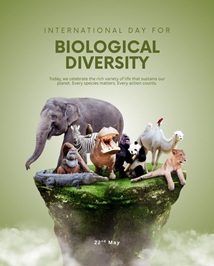
On 22 May, the world observes the International Day for Biological Diversity, a day that reminds humanity that life does not exist in isolation.
The theme for 2026, “Acting Locally for Global Impact,”
carries a message both simple and profound: the future of the planet depends not only on governments and organizations, but on ordinary people and the choices they make every day. A single action performed with awareness can travel farther than imagined, much like a tiny seed growing into a sheltering tree.
Biodiversity refers to the variety of life found on Earth — plants, animals, birds, insects, microorganisms, forests, oceans, rivers, deserts, mountains, and every ecosystem that breathes life into the planet. But biodiversity is more than a scientific concept hidden within textbooks. It is the fragrance of wet soil after rain, the comforting shade of a tree on a summer afternoon, the cool breeze flowing through fields, and the sound of sparrows returning home at dusk. It is woven deeply into human existence, often so quietly that people forget how dependent they truly are on nature. Human beings survive because biodiversity survives.
Every grain of rice on a plate, every fruit sold in markets, every medicine consumed during illness, and every breath taken without thought is connected to the natural world. Bees pollinate crops that feed millions. Forests absorb harmful gases while gifting oxygen freely. Wetlands filter water like nature’s own purification system. Mangroves protect coastal communities during storms. Even the smallest organisms hidden beneath the soil play a role in maintaining fertility and sustaining agriculture.
Nature has always cared for humanity with the tenderness of a mother — silently, endlessly, and without conditions. Yet despite receiving so much from the Earth, humanity has often failed to return the same kindness. Forests are disappearing beneath concrete. Rivers once worshipped for their purity are now burdened with pollution. Countless species are vanishing before future generations even get the chance to witness them. The modern world, in its race for development and comfort, has slowly forgotten that progress built at the cost of nature is not progress at all — it is destruction disguised as advancement.
Scientific studies now warn that nearly one million species across the globe face the threat of extinction due to human activities. Behind this number lies a heartbreaking reality. Every extinct species is not merely a lost organism; it is the disappearance of a voice from Earth’s choir. Imagine a world where children grow up hearing about elephants, butterflies, tigers, or sparrows only through photographs and stories. Imagine rivers running dry, forests falling silent, and skies empty of migrating birds. Such a future no longer belongs to imagination alone; it is approaching quietly if humanity continues to ignore the warning signs.
The impact of biodiversity loss can already be felt in everyday life. Summers are becoming harsher, rainfall patterns more unpredictable, air quality more dangerous, and natural disasters more intense. Crops suffer when pollinators decline. Water scarcity increases when forests disappear. Climate change deepens when ecosystems collapse. The suffering of nature eventually returns to humanity itself, because the bond between humans and the environment is inseparable.
And yet, amid these growing challenges, hope still exists.
That hope lies in awareness.
Awareness is where conservation truly begins. Laws may protect forests on paper, but only awareness can protect them in people’s hearts. When individuals begin to understand that they are part of nature rather than separate from it, their relationship with the environment changes completely. A person who values a tree will hesitate before cutting it down. A child who grows up feeding birds will never take wildlife lightly. Awareness transforms indifference into responsibility and responsibility into action. Today, the need for environmental awareness has become greater than ever before. Schools and colleges must encourage students not only to memorize definitions of biodiversity but also to emotionally connect with the living world around them. Children should be taught to recognize birds, understand the importance of insects, appreciate rivers, and respect forests. Because when love for nature is planted early, conservation becomes instinctive rather than forced.
Social media and digital platforms can also play a powerful role in spreading awareness. A single meaningful message, documentary, plantation campaign, or wildlife photograph can inspire thousands of people. Communities can organize cleanliness drives, biodiversity walks, tree plantations, and awareness programs that reconnect society with nature. Conservation does not always require grand gestures; often, the smallest acts create the deepest impact.
A person saving water at home, refusing single-use plastic, planting native trees, feeding birds during summer, protecting stray animals, or encouraging sustainable habits is contributing toward biodiversity conservation. Humanity must realize that protecting nature is not a favour done to the environment — it is an investment in its own future.
The 2026 theme reminds the world that change begins locally. A small village preserving its pond protects aquatic life. A family choosing sustainable living reduces environmental harm. A community planting trees cools entire neighbourhoods. Like countless drops forming an ocean, individual efforts together become powerful enough to restore balance to the planet.
India itself is blessed with extraordinary biodiversity — from the mighty Himalayas to dense forests, fertile plains, deserts, rivers, mangroves, and rich wildlife. This natural wealth is not merely a national treasure; it is a sacred inheritance passed down through generations. Preserving it is both a duty and a responsibility.
The International Day for Biological Diversity is therefore not just another environmental observance marked on calendars. It is a reminder that humanity’s future depends upon the choices made today. The songs of birds, the fragrance of forests, the beauty of blooming flowers, and the rhythm of flowing rivers are not guaranteed forever unless people choose to protect them.
Nature has always spoken softly, yet its silence carries wisdom deeper than words. It teaches coexistence, patience, balance, and resilience. The Earth does not ask humanity for perfection. It only asks for care. If awareness spreads from one heart to another like light passing through darkness, conservation will no longer remain a distant goal. And perhaps one day, future generations will inherit a world where forests still whisper in the wind, rivers still sing through valleys, butterflies still dance over flowers, and humanity once again learns to live beside nature with gratitude rather than greed.
“The Earth does not belong to us;
we belong to the Earth.”
-Chief Seattle
—
*Active Conservationist and Student Member, BNHS